Three kinds of award
| Award | What decides it | How many get one |
|---|---|---|
| Adjudication | The routine’s score, against the company’s scale (Gold, High Gold, Platinum…). | Many routines can earn the same level in the same category. |
| Overall | A ranking of the highest scores within a group, usually an age division and level. | A few in each group: a top 3, a top 10, or first place in a category. |
| Special | The judges’ choice: entertainment, costume, choreography, a standout dancer. | A handful in each session or event. |
Adjudication: scored, not ranked
Judges score each routine on its own, usually out of 100 points each, and the judges’ scores are added together. Where the total falls on the company’s scale decides the award. Routines are not being compared with each other at this stage, which is why a studio can bring home several Platinums in the same category. In the companies’ own words:
- KAR: “Contestants are not being ranked against each other.” Its scale is “Elite Ultimate Performance, Elite Top First Place, Top First Place, First Place, and a High Second.”
- StarQuest: “multiple Ultimate Platinum (Select Only), Platinum Plus, Platinum, High Gold, and Gold adjudication awards may be presented within each age division for each category of competition.”
- Showstopper: category awards “are based on predetermined point ranges … Multiple awards may be presented within the same age group and category.”
Sources: KAR, Parent Center; StarQuest, 2027 Regional and Finals Awards; Showstopper, 2027 Rules & Tour Info; all read October 4, 2026.
What the judges score is in the rules too. KAR’s 2027 rules, for example, give Technique 40 points, Stage Presence 25, Execution of Performance 20, Choreography 10 and Overall Impact 5. 24 Seven and NUVO weight Technique 50%, Performance 20%, Choreography & Musicality 20% and the overall performance or appearance 10%.
Sources: KAR, 2027 Rules and Regulations; 24 Seven, Competition Info; NUVO, Competition Info; all read October 4, 2026.
Published score scales, 2026–27 season
These four companies publish the score range for each award level. Totals are out of 300: three judges, 100 points each, or the company’s combined score. The same name means a different score at each company, so compare a result with its own company’s scale, not another’s.
| Company | Award levels and published ranges |
|---|---|
| StarQuest Select level |
|
| StarQuest Nova and Classic levels |
|
| Hall of Fame American League |
|
| Hall of Fame Other leagues |
|
| 24 Seven |
|
| NUVO |
|
* As printed on NUVO’s page; it overlaps Gold’s range, so check with your studio. Hall of Fame’s rules also name a high-silver level but give no range for it.
Sources: StarQuest, Adjudication Sheet 2027 (three judges); Hall of Fame, Awards & Rules (2027 season, total of three judges); 24 Seven, Competition Info (2026/27, combined scores); NUVO, Competition Info (2026/27, combined scores); all read October 4, 2026.
Companies that don’t publish their ranges
Many companies name their award levels in their rules but share the point ranges only with studios, or not at all. Your studio director can tell you where a score falls.
| Company | What the 2026–27 rules publish |
|---|---|
| KAR | Levels: Elite Ultimate Performance, Elite Top First, Top First, First Place, High Second. Three judges at regionals, “a maximum of 100 points per judge”. Ranges: “The studio directors will have the exact point breaks for all awards given at KAR.” |
| Showstopper | Levels: Crystal Award (Competitive Level only), Double Platinum, Platinum, Gold, Silver. “Based on predetermined point ranges”; the ranges are not printed. |
| Starpower | “Each routine is awarded an adjudicated pin that is pre-determined based on a scoring system. Each judge has 100 points to allocate.” No level names or ranges are printed. |
| VIEW Dance Challenge | 2027 Nationals: “Based on the combined score of all five judges, each entry will receive a silver, high silver, gold, high-gold, platinum or platinum plus award.” No ranges printed. |
Sources: KAR, 2027 Rules and Regulations and Parent Center; Showstopper, 2027 Rules & Tour Info and 2027 Regional Rules & Regulations (PDF); Starpower, 2026-2027 SDA Rules & Regulations; VIEW, 2027 Nationals Awards; all read October 4, 2026.
Overalls and high scores
Overalls are where routines are ranked. The highest-scoring routines in a group, usually an age division and a level, are called up in order, often with a trophy, a banner, a scholarship or a gift certificate for the studio. The names vary: KAR calls them Overall High Point Awards, StarQuest “Top Score”, Hall of Fame Top Scores. Showstopper recognizes “the Top 10 routines in each of the following age divisions”, and Starpower’s routines “are scored and ranked within their level, genre and age division.”
A routine usually has to perform in its scheduled place to be ranked. KAR: “All acts must perform before their awards ceremony to be eligible for Overall High Point Awards.” Showstopper: “Routines must perform in their assigned awards session to be eligible for overall awards.” A routine that performs out of place may compete for adjudication only: it gets its level, but no overall.
Sources: KAR, 2027 Rules and Regulations; StarQuest, 2027 Awards; Hall of Fame, Awards & Rules; Showstopper, 2027 Rules; Starpower, 2026-2027 SDA Rules; all read October 4, 2026.
Special awards, titles and scholarships
Special awards are the judges’ picks, separate from the score. Every company has its own: KAR gives Judges’ Choice, Best Costume and Most Entertaining awards; Hall of Fame’s judges choose achievement awards such as “Showmanship, Fabulous Feet, Broadway Diva, Intensity and Costume”; 24 Seven gives the 11 O’Clock Number Award to the routines “the judges feel are, overall, the most technical AND entertaining”; StarQuest presents Judges Special Awards “at every awards ceremony”.
Some awards are for one dancer: titles (a separate solo contest you usually register for), scholarships to a convention, and invitations to a company’s summer program or finals opening number. They are often announced at the same ceremony.
Sources: KAR, 2027 Rules and Regulations; Hall of Fame, Awards & Rules; 24 Seven, Competition Info; StarQuest, 2027 Awards; Showstopper, 2027 Rules (All-Star opening number); Starpower, 2026-2027 SDA Rules (title); all read October 4, 2026.
What the awards ceremony is like
Awards usually come after a block of routines, sometimes hours after your dancer performed. Dancers from each routine go on stage, often in costume or a studio jacket, and sit or stand by studio while the levels are read out, then the overalls in order, then the special awards. Families watch from the audience. Ask your studio where the dancers meet and what they wear.
Some companies hand out part of it off stage. KAR, for example, uses “Grab & Go Group Awards”: “Immediately following their performance, group dancers may visit the Grab & Go Awards Table to receive their General Awards,” which leaves the ceremony for specialty awards and the overalls.
Source: KAR, 2027 Rules and Regulations, read October 4, 2026.
Where to find the scores and critiques
The award is announced on stage; the score and the judges’ comments usually come later, and often to the studio rather than to you:
- KAR: “Score sheets and judge’s commentaries are available online only to Studio Directors.”
- StarQuest: Score Sheet Summaries go to studio directors, with video critiques from all three judges “by 6 PM on Tuesday after the conclusion of the competition”.
- 24 Seven and NUVO: score sheets and online critiques go, within 24 hours, to the account the routine was registered from.
- Showstopper: “Every routine receives written and audio commentary from each judge.”
Sources: KAR, Parent Center; StarQuest, 2027 Awards; 24 Seven and NUVO, Competition Info; Showstopper, 2027 Rules; all read October 4, 2026.
Keeping track of a season’s results
Over a season, results blur together. On paper, keep one line per routine for each competition: the award level, the score if your studio shares it, any placement and special award, and one thing the judges said. At the end of the season it shows how each routine grew.
Or keep them in Ovation
In Ovation, the dance family planner for iPhone, you send the competition’s results sheet as a PDF, a photo, pasted text or a link. Ovation finds your dancer’s routines and fills in their awards for you to check. Or type them in: only the award is needed, and the score, placement and special awards are optional.
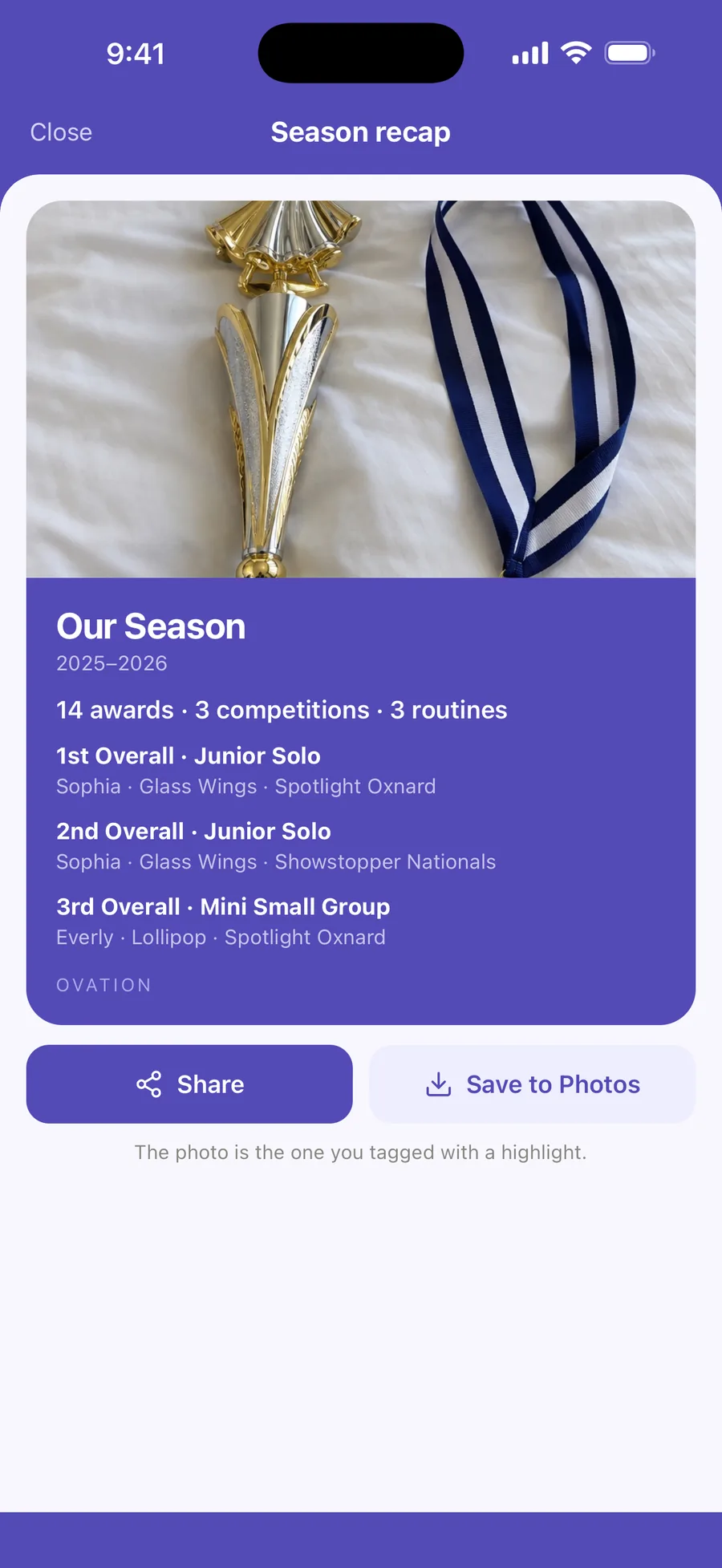
The Awards tab adds up every result, season by season, and the Season recap puts the season on one card to share or save. You can tag the awards a photo shows, and it appears beside those results.
A results import is one of the free plan’s first two AI imports; Ovation Pro has no limit.
Import results Record results The Awards tab Tag awards on a photo
How we checked
We read each company’s own rules, awards page or score sheet for the 2026–27 season (which several companies call their 2027 season) on October 4, 2026, and copied the levels and ranges as printed. Where a company doesn’t publish its ranges, we say so rather than estimate them. Rules change between seasons, and your studio’s copy of the rules is the one that counts. Ovation is a planning app for dance families by Selvi Labs; it is not a competition company and is not affiliated with any company on this page.
- StarQuest: Adjudication Sheet 2027 (PDF); 2027 Regional and Finals Awards
- Hall of Fame Dance Challenge: Awards & Rules
- 24 Seven Dance Convention: Competition Info
- NUVO Dance Convention: Competition Info
- KAR: 2027 Rules and Regulations; Parent Center
- Showstopper: 2027 Rules & Tour Info; 2027 Regional Rules & Regulations (PDF)
- Starpower: 2026-2027 SDA Rules & Regulations
- VIEW Dance Challenge: 2027 Nationals Awards
All read October 4, 2026.